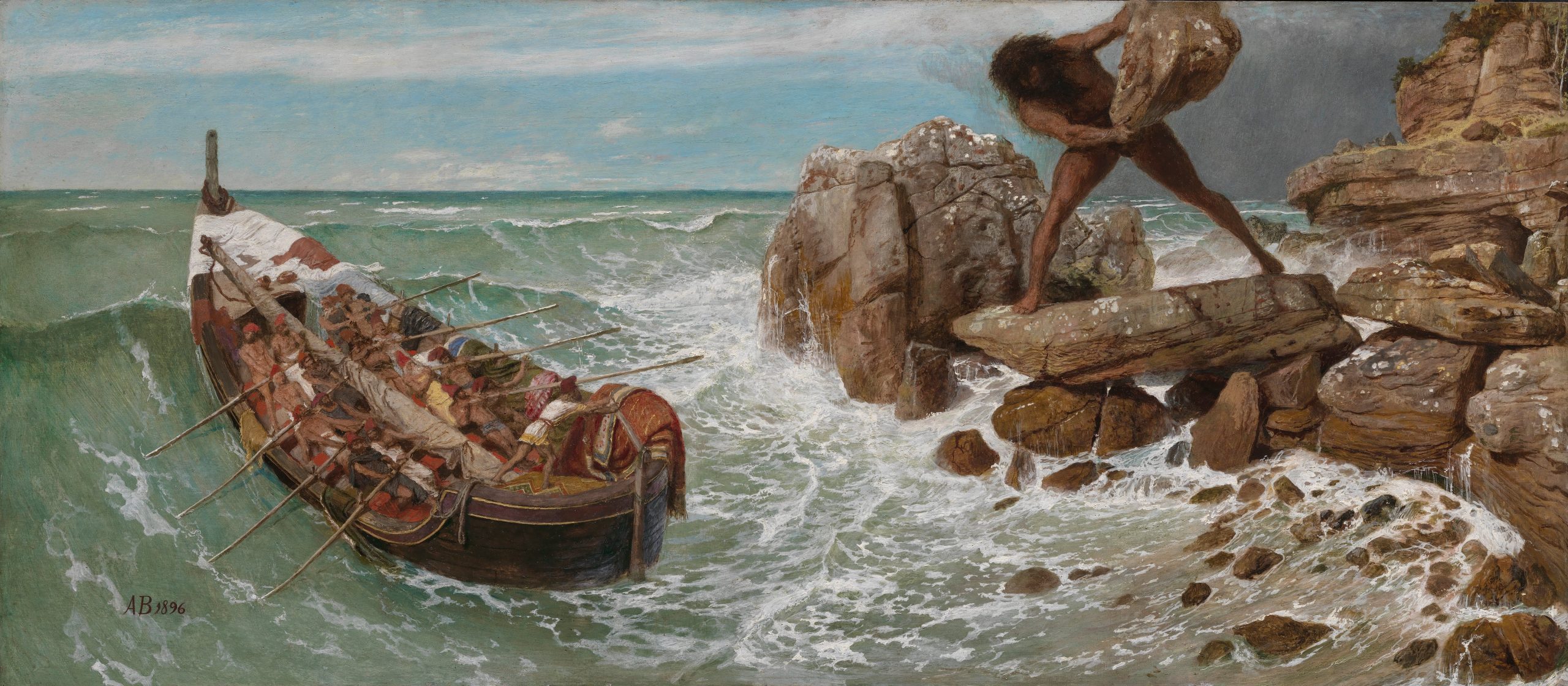
In Christopher Nolan’s adaptation of Homer’s great epic, Odysseus arrives home ten years late because he senses a tragic truth: the home he knew no longer exists. The giants, monsters and nymphs who lead him astray are a welcome distraction from the realization that his return will not bring him back to the homeland he longs for so painfully.
The hero spends seven years with the caring Calypso, lost in the lotus-induced haze that makes him forget. For he is tormented by a guilty conscience. Not because of the infidelity to his wife Penelope — the ideal of romantic monogamy had not yet been invented — but because he holds himself responsible for an unstoppable transformation spreading like a plague through his homeland. At its end lies nothing less than the end of civilization.
What if God was one of us
This civilization is built on a very particular morality: the Law of Zeus. In the ancient seafaring culture of the Odyssey, it guarantees decent treatment among human beings. Zeus’s law was actually called Xenia and refers to the ancient Greek concept of hospitality: an institutionalized relationship based on generosity, the exchange of gifts, and reciprocity. Historically, hospitality toward strangers and guests was understood both as a moral obligation and as a political necessity.
Xenos translates as both “stranger” and “guest” — a remarkable difference from the way we think today. Every stranger is, first of all, a guest, to whom protection, food, and shelter must be granted. Xenia shaped social norms for thousands of years, (however, only among free men). A recurring motif in Greek mythology is that gods appear as poor wanderers or destitute strangers in order to test whether human beings uphold the law of hospitality. Telemachus, the son of Odysseus, therefore says to Penelope’s suitors: “The law of Zeus commands us to treat strangers as we ourselves wish to be treated, for they may be gods in disguise.”
Two and a half millennia later, the great moral philosopher of the Enlightenment, Immanuel Kant, reaches a similar conclusion entirely without the religious foundation: “Act only according to that maxim which you can at the same time will to become a universal law” (cf. Kant 2024). Or, simply put: “Do unto others as you would have them do unto you.” It is from this school of thought that human rights emerged — perhaps the greatest achievement of modern European civilization.
The Crumbling of Civilization
In the world of the Odyssey, Zeus’s law still exists, but it is increasingly trampled underfoot. The suitors on Ithaca abuse the laws of hospitality, harass Penelope, and eat their way through her provisions; the enemies of Odysseus seize supplies from the inhabitants of Ithaca by force — and when the hero returns decades later as a beggar to his own home, he is mocked and beaten rather than welcomed with hospitality. The culture of hospitality crumbles.
Yet the greatest rupture with Zeus’s law has happened years earlier: The Trojan Horse — the legendary idea of Odysseus — undermines the divinely ordained boundaries of what human beings are allowed to do to one another. The cruel deception of the deadly gift of hospitality in the form of a wooden horse filled with soldiers shifts the moral landscape. A new space of possibility opens up in which the other person becomes an object to be used in the satisfaction of one’s own objectives — beyond divine laws. It is the logic of calculating reason, which subjugates everything else to itself and stops at nothing, not even Zeus.
With the Trojan Horse, decency collapses and barbarism spreads. The film reaches its climax when Odysseus realizes: his nasty trick may have made him a hero, but it has unleashed a transformation he can no longer stop. His longing for home, for return, for the old world, will no longer be fulfilled. When he finally reaches his Ithaca, it’s no longer the same. The future he spent more than twenty years searching for is lost.
Longing for the Lost Future
Nolan’s film is a vivid mirror of the great cognitive crisis of our time: the future we once believed in no longer beckons us. We are homesick for a future that no longer exists. And like Odysseus, we are not sure where our journey is supposed to lead us.
Modern humanity set out to improve the world through maximization and rationalization: progress was supposed to create prosperity, technology make life easier, and equality enable all people to live lives of dignity. Yet the great promises of modernity increasingly turn against us. Instead of prosperity for all, wealth and power are increasingly concentrated in the hands of a tiny elite. Instead of making our lives easier, we increasingly find ourselves struggling against technologies that relentlessly consume our lifetime. And instead of equality, narratives of the Other as inferior are once again creeping in… The golden future of progress has withered away, leaving behind a gaping void: if the future we once believed in no longer guides us, where do we, as a society, want to go?
The moral integrity of a person or a culture is revealed not only in Odysseus’s world by the way it treats the poor, the beggars, and strangers. When thousands drown in the Mediterranean under our watch, when xenophobic violence explodes and fascist parties become mainstream, it reveals a moral decay that initially affects only the weakest but — as history shows — ultimately erodes society as a whole.
Nolan’s Odyssey revolves around the question: How do we treat people whose identity we do not know? And how does this behavior affect our culture? These uncomfortable questions reveal just how wide the gap between our European ideals and the reality of our actions has become. Human rights today sound almost ancient: “The dignity of the human being is inviolable.” A beautiful, a noble idea. The problem is: it is legitimized by nothing other than human beings themselves.
We do not have to fear Zeus’s thunder when we break it. Modernity made reason the measure of all things, but postmodernity has deconstructed our entire world as something human-made, subjective, and arbitrary. There is no higher-order principle anymore. No God.
The Illusion of the Enlightenment
Redemption could come from within ourselves. From our own tradition of knowledge. For one of the great strengths of the European high cultures, from antiquity to the present, is their capacity for self-reflection and integrating criticism for reaching a new level of complexity. And, of all things, philosophy — also an invention of the ancient Greeks — has for years been giving shape to a new movement that emancipates itself entirely from modern and postmodern thinking: New Realism.
“Under the banner of a New Realism, a philosophical movement has formed that opposes postmodern constructivism and imperialistic naturalism alike,” is how Markus Gabriel, the star of the movement, sums it up (cf. Gabriel 2016). He is considered a philosophical prodigy, became a professor for the first time at the age of 29, speaks nine languages, and reads the ancient philosophers in the original. He believes that both in antiquity and in the Enlightenment of the modern age, we took a wrong turn.
According to Gabriel, Enlightenment thinkers overestimated themselves and reflected too little on their own preconceptions. They believed that reason could identify universally valid principles without taking other people’s perspectives into account. Kant was not only an outstanding philosopher, he was also a racist and misogynist. He believed he had discovered the principle of ethics entirely by himself, “without speaking to those who held a different view” (cf. Schuppisser 2024). The Enlightenment therefore never reached the point of reflecting on its own biases. Markus Gabriel calls for a more radical Enlightenment that goes further and critically questions its own conditions.
The path to knowledge lies in the “multiperspectivity of human experience” (ibid.). This is by no means about claiming that every perspective is equally correct, but about expanding one’s own space of knowledge. It is about a new form of Enlightenment that takes its own fallibility seriously.
The Hidden Law of the Good
This New Realism does not advocate an equivalence of different cultural perspectives — not at all! Markus Gabriel argues for a morality that exists entirely independently of human cultures. He speaks of moral facts that exist and that we can recognize. According to Gabriel, these moral facts are facts in exactly the same way as scientific facts. The statements “Water consists of H₂O” and “It is wrong to torture an innocent person” are both true in the same way. In doing so, New Realism breaks with a tradition thousands of years old, stretching from the ancient philosophers through the Enlightenment: the separation of IS and OUGHT as independently existing worlds.
This means that morality is not invented by us, but is part of reality that we can come to understand. Like Zeus’s law, moral facts exist entirely independently of opinions, cultures, or personal preferences — and that is precisely what gives them their power.
To recognize them as clearly as possible is not some ivory-tower exercise for philosophers, but a central task for society as a whole. For when people permanently act against fundamental moral facts — for example, by legitimizing selfishness, violence, and discrimination — they ultimately destroy the social system itself, which cannot function without a basic moral structure.
A New Horizon
New Realism is a very young movement, but it has been spreading fast in the last ten years and is being adapted and debated internationally. A new idea has been born.
It could mark the beginning of a second wave of Enlightenment that guides us beyond crisis and into a new future, in which we will have a radically new understanding of morality and ethics — a godless version of Zeus’s law, grounded in multidisciplinary scientific knowledge.
The impact of this movement is astonishing. It offers a vision in an age that has lost its horizon, a new sense of direction in our search for an answer to the question: where are we heading? New Realism could be a path into the next society. For civilizations either continue to evolve — or perish. Morality, that is, the question of the Good, can guide a culture and help it reshape better than questions of technological feasibility, efficiency, and maximization. A society without ethics, by contrast, destroys itself.
Nolan, too, does not leave us with a dystopia. At the end, Penelope and Odysseus sail westward once again happily reunited, and bring the great story to a close with the following exchange:
“The civilization will rise again,” she says.